
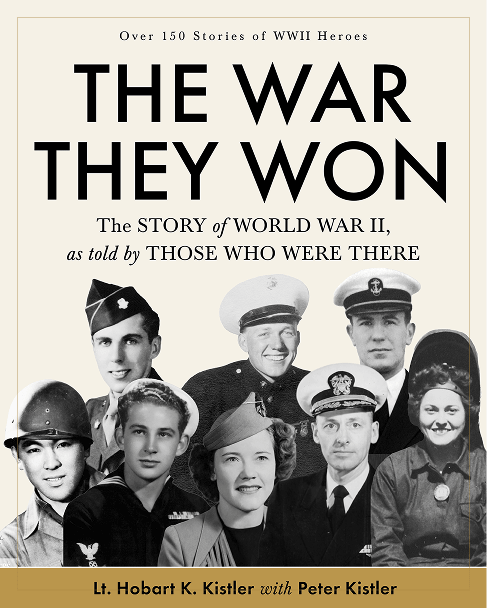
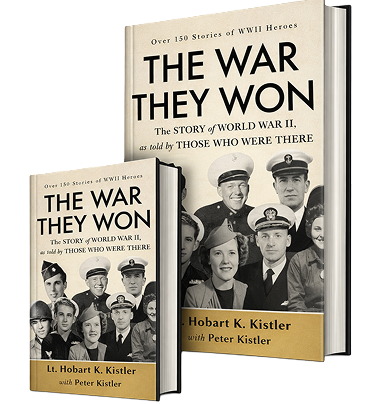
The War They Won
The story of World War II, as told by those who were there.
Lt. Hobart K. Kistler, USN ✦ Peter Kistler, Editor
17 years. 200+ veterans. The last firsthand record of WWII. Drawn from interviews with the men and women who fought and sacrificed to defeat the Axis powers, captured before reliable memory was lost forever.
“Available Now · Golden Acorn Press”
Advance Praise
What people are saying.
Advance reader reviews and editorial endorsements from veterans, military historians, and educators
"A must read for anyone who wants to learn more about WWII. The personal experiences made the book come alive."
— Col. Walter J. Marm, USA (Ret.), Medal of Honor recipient
"A grippingly personal narrative about the World War II experience, guaranteed to captivate and evoke deep emotions."
— Adm. Frank Caldwell, USN (Ret.)
"From the beaches of D-Day to the carrier decks of Midway, their words ring with an immediacy from those that were there."
— Jeffry D. Wert, military historian and author of “The Heart of Hell: The Soldiers’ Struggle for Spotsylvania’s Bloody Angle”
Why This Book, Why Now
Time is the enemy of memory.
A person who was 18 in 1945 is 99 today.
By 2036, the war will have passed almost entirely from living memory. Once the last of these voices is gone, no historian, no museum, no documentarian will ever be able to ask a survivor what it was actually like.
Once these voices are gone, a book like this can not be made again.
<0.5%
of the 16.4 million Americans who served in WWII are still alive in 2026
Source: U.S. Department of Veterans Affairs
By the Numbers
The scope of seventeen years of work.
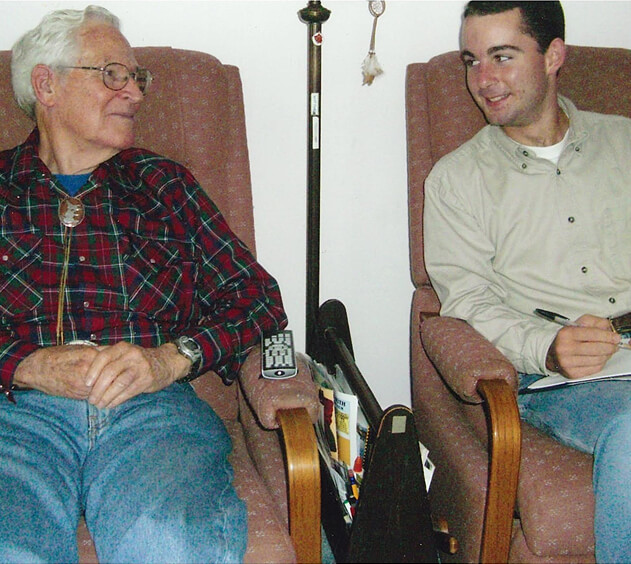
For seventeen years, Hobart Kistler raced that clock. He interviewed more than 200 of these men and women, in living rooms, at kitchen tables, on porches in Central Pennsylvania and across the country. He kept meticulous track of the lifespan of each of his interviewees. He stopped only when their reliable memory began to fail, and the work could go no further.
17
Years of Interviews
200+
Veterans Interviewed
150+
Voices in the Book
200+
Photos & Maps
About the Book
A history of the war in the voices of those who lived it
From the opening attack on Pearl Harbor, through the European and Pacific theaters, to the far-flung corners of the world, The War They Won is a journey alongside the brave men and women who fought and sacrificed to defeat the Axis powers. This narrative-driven account of the Second World War is told by those who experienced it firsthand.
Unlike most WWII books, which tend to be either broad historical surveys or single-veteran memoirs, The War They Won weaves more than 150 firsthand accounts into one continuous narrative covering the entire conflict. It is not a collection of stories. It is the war itself, told in the words of those who fought it. As Tom Kistler puts it: “I have reviewed a number of other WWII books, and The War They Won is unique in that it is truly about the war, not just a bunch of stories. Hobart brought the reader along on a four-year journey through all the theaters, including the out-of-the-way places where little-known fighting took place.”
The author, the late Lt. Hobart K. Kistler, USN, personally interviewed more than 200 veterans. This work of seventeen years began with a single Christmas Day conversation when he was 14, and continued through high school, the U.S. Naval Academy, three Navy deployments, and beyond. The voices of more than 150 of those veterans form the core of this book.
The book covers every major battle of the war: Pearl Harbor, the Battle of the Atlantic, Normandy, the Battle of the Bulge, Guadalcanal, Iwo Jima, and Okinawa, as well as battles in lesser-known theaters such as the Aleutians, North Africa, and China-Burma-India. Each chapter features the voices of the men and women who served, with historical context and descriptions of the environment. More than 200 photos, custom maps by Purple Lizard Maps, and original images bring the text to life.
I. Trust earned in living rooms.
Hobart earned the trust of men and women who hadn’t spoken about the war in decades. After each interview, he provided a written summary to the veteran and their family. Through those write-ups, spouses and children understood, often for the first time, the experiences that had shaped their loved ones’ lives decades ago.
II. Built for readers, not just historians.
Plain-language narration, footnotes for terminology, and more than 200 photos and maps make this book accessible to a young adult or a non-military adult reader, while rewarding the serious enthusiast.
III. The full breadth of who served.
Combat troops, yes, but also support roles, stateside assignments, and the men and women who weren’t sure their service contributed. It is the story of a generation as much as the stories of the soldiers alone.
From the Book
In their own words.
Four passages: the project’s origin in 2004, the moment the war begins, the human cost of going ashore, and finally, the way it felt to come home.
✦ From the Preface ✦
“It all began with a chance conversation on Christmas Day 2004. In the midafternoon lull that often precedes family holiday meals, I plopped down on the couch beside my maternal grandfather, Jim Fogel, to peruse my brand-new National Geographic Atlas of the World.”
“Pop-Pop, can you show me where you were during the war?”
“In reviewing ten years and thousands of hours well-spent, I can proudly count more than 200 stories in my files, more than 200 friends made. And while the project’s aim has always been to preserve these veterans’ stories for their families, it is at the collective behest of my aged heroes that I take pen in hand in this attempt at fairly presenting The War They Won.”
Hobart K. Kistler, Portsmouth, VA · February 2021
✦ From Chapter 1: Remember Pearl Harbor ✦
“Sunday, December 7, 1941, dawned languidly on the Hawaiian island of Oahu. A few minutes before 8 o’clock, 24-year-old Ensign Maury Werth was wrapping up a long night as Junior Officer of the Deck on light cruiser Raleigh.”
“Moments later, the old cruiser was rocked by a tremendous explosion. ‘My first thought was, My God, one of the boilers has exploded!’ Werth relates. ‘I ran topside, dressed only in my skivvies, to find the Officer of the Deck.’ Any thoughts of an accidental explosion were soon forgotten. ‘There were dozens of planes flying close overhead, and, looking aft, I saw the ripples where a torpedo had struck our port side. Pearl Harbor was under attack, and the red balls on the planes’ wings told us who was responsible.'”
Ensign Maury Werth, USS Raleigh · December 7, 1941
✦ From Chapter 11: V-E Day and the Occupation ✦
“After losing 30 pounds as a POW, former airman Joe Conlon was decidedly less sentimental about his trip home. ‘By that point I didn’t care how I got home,’ Conlon affirms. ‘I bought a box of 24 Hershey bars from the ship’s store, took them down to my bunk, and sat there and ate the whole damn box! I didn’t even get sick!”
“When we got to New York, I was given a 30-day furlough, so I phoned my father to let him know that I was coming home. My dad wasn’t the kind to show affection, but he met every train that came into the station for the next three days, until I was finally on one of them. We walked home and sat in the kitchen and talked for hours.”
Joe Conlon, U.S. Army Air Forces · POW, European Theater
✦ From Chapter 18: MacArthur's Return ✦
“From those early days in boot camp when they tell you you’ll be cannon fodder if you don’t keep up with the group, there’s really nothing that comes close to preparing you to hit the beach for the first time,” Bob MacGregor relates.
“I remember one guy sitting in a corner of the landing craft, crying his eyes out. ‘I can’t go in; I’m scared to death,’ he kept saying. I crawled over to him, looked him in the eye, and said ‘I am too.’ Then we shook hands, and agreed to go at it together. He was killed before he even made it to shore. You know, I still lie in bed at night and can’t sleep thinking about that poor, brave boy.”
Bob MacGregor, U.S. Army platoon leader · Leyte landings, 1944
The Project
Seventeen years. One question that started it all.
It began on Christmas Day, 2004. Hobart was fourteen. He took down a brand-new atlas, walked over to his grandfather, and asked where he had served during World War II.
That conversation cracked open a door that never closed. By high school, Hobart’s interviews had moved beyond family and church to neighbors, friends of friends, and any veteran who would talk to him. By the time he graduated, the project had outgrown school-credit territory entirely. Hobart just kept going.
He carried the project with him to the U.S. Naval Academy, where he graduated with distinction, and to Johns Hopkins University, where he earned a graduate degree. He kept interviewing through three deployments in support of the Global War on Terror, and through a staff assignment at the Office of Naval Reactors in Washington, D.C.
The veterans saw something in him: first his honest, candid curiosity, then his deep historical knowledge, and finally his own commitment to service through the U.S. Navy. He earned the trust of men and women who had not spoken about the war in decades.
When confined by the COVID pandemic in 2020, Hobart used the unexpected stillness to do what he had been planning for years: reshape more than 200 interview write-ups into a single book covering the entire war.
About the Author
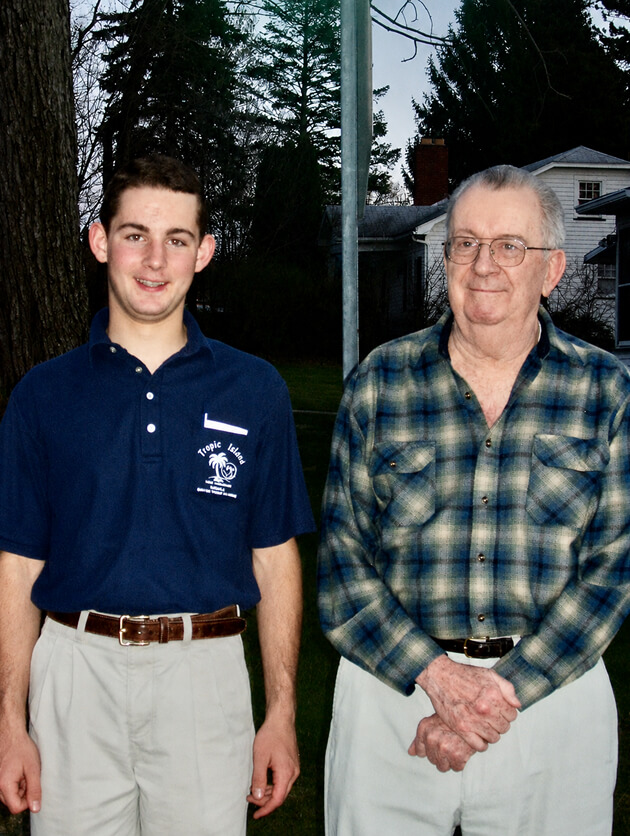
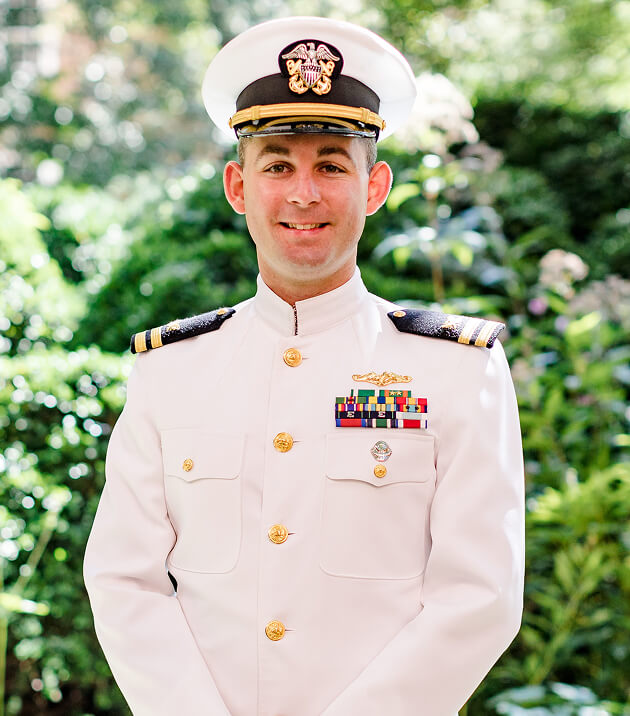
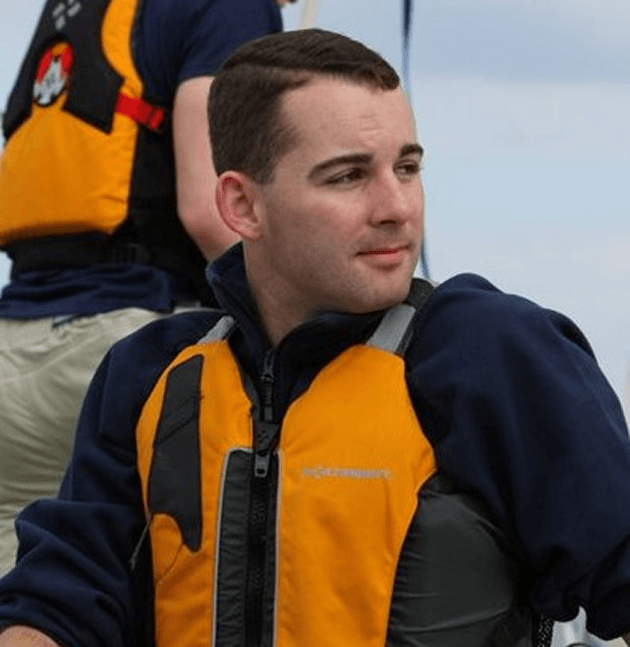
Lt. Hobart K. Kistler, USN.
A native of Central Pennsylvania, Hobart Kistler graduated with distinction from the U.S. Naval Academy and Johns Hopkins University. From 2013 to 2021, he served as an officer in the U.S. Navy, completing three deployments in support of the Global War on Terror, as well as a staff assignment in Washington, D.C., in the Office of Naval Reactors.
He was, his family says, an old soul. Even as a teenager in the 2000s, he owned a record player, wrote letters by hand, and was the youngest regular caller to his local 50s/60s radio station by about forty years. Many of his deepest friendships were with people three and four times his age. His historical curiosity began in childhood with the Civil War (he led the Gettysburg tour as a sixth grader) and naturally widened to include the Second World War.
Beyond his work as an oral historian, Hobart published two family histories and was a member of the Society of the Cincinnati, the Sons of the American Revolution, and the Military Order of the Loyal Legion of the United States, among additional hereditary military history societies. He was a 2006 Eagle Scout and a recipient of the William T. Hornaday Conservation Medal, one of Scouting’s rarest honors.
Hobart completed the manuscript in 2021. He did not live to see it published. The manuscript he left behind was exactly the way he wanted it to be, ready, in his eyes, for publication. He is survived by his wife and daughter.
Bringing It Home
A family carries the work across the finish line.
Hobart entrusted his manuscript to his brother Peter, his editor and confidant, whose keen eye and writer’s instincts had shaped Hobart’s earlier work. In the years that followed, Peter and their parents, Tom and Mary Jane Kistler, carried this project to publication.
Peter Kistler, Editor
Peter had helped Hobart with his earlier writing projects since the brothers were teenagers. In early 2021, when Hobart called to say his 200+ interview write-ups were finally in the shape of a manuscript, the two of them worked together, trading notes online to shape the text into its final form.
In the years that followed, Peter set himself a single, careful task: to honor the spirit of his brother’s authorial intent. With his family, and with Golden Acorn Press, he saw the book through to publication exactly as Hobart would have wanted it.
Tom & Mary Jane Kistler
Hobart’s parents supported the project at every stage, from the early years when their teenage son began driving around Central Pennsylvania with a notebook, to the long final stretch of finding a publisher who believed in the work. Both have been deeply involved in seeing the book to launch and welcome contact from veterans’ families and readers alike.
Dedication
To the brave men and women who volunteered and who answered the call, and who left the safety of home and country to defend the world against the scourge of fascism.
From the book’s front matter
For Veterans’ Families
Was your loved one interviewed by Hobart?
If your father, grandfather, mother, grandmother, uncle, or aunt was interviewed by Hobart Kistler, or if you believe they may have been, the Kistler family would love to hear from you. We also welcome contact from anyone with a WWII connection to the book.
Reach the Kistler Family
Send us your name and a note about your veteran. We’ll be in touch personally.
For Educators & Libraries
A classroom-ready oral history resource.
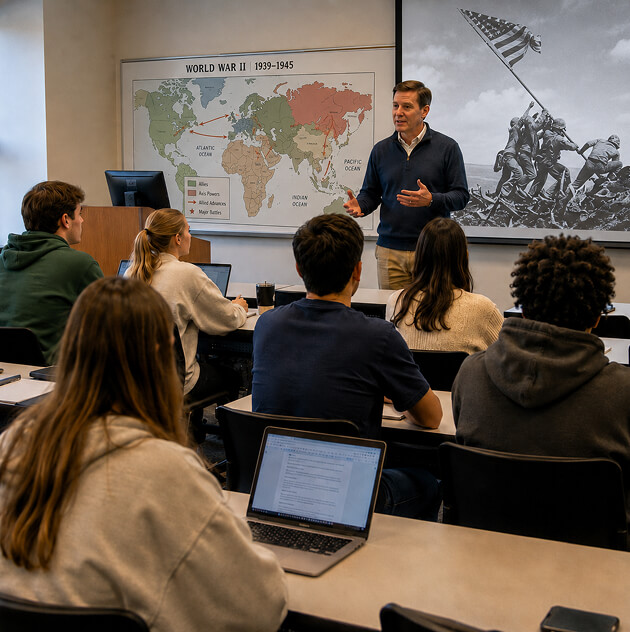
The War They Won was written to be approachable for any young adult or non-military adult reader who is not steeped in military terminology. Plain-language narration, footnotes throughout, custom maps by Purple Lizard Maps, and more than 200 photographs make it accessible without sacrificing depth.
The book also includes Hobart’s “How to Interview Your Vet” guide, a practical, generous walkthrough drawn from his seventeen years of experience. It is a ready-made resource for history classrooms, journalism programs, scout troops, and any community wanting to capture the stories of the veterans still among us.
Frequently Asked Questions
Answers, at a glance.
About the Book
What is The War They Won about?
The War They Won is a narrative history of World War II told primarily through the firsthand voices of more than 150 veterans, men and women, gathered over 17 years by the late Lt. Hobart K. Kistler, USN. With fewer than 0.5% of those who served still alive, it is one of the last firsthand records of WWII that can be assembled.
What makes The War They Won different from other WWII books?
Most WWII books are either broad historical surveys or single-veteran memoirs. The War They Won weaves more than 150 firsthand veteran accounts into one continuous narrative covering the entire war, featuring a wide variety of voices and perspectives. Because nearly all of these veterans have since passed, the book is one of the last firsthand records of WWII that will ever be assembled.
Is this more like a military history book or a personal story?
Both. If you enjoy the firsthand storytelling of Band of Brothers and the larger historical understanding of The Greatest Generation, The War They Won brings those experiences together in one book. It combines personal interviews, major battles, overlooked theaters, and historical context into a single narrative that helps readers understand not just what happened during World War II, but what it felt like to live through it.
What battles and theaters does the book cover?
The book covers the entire war in 24 chapters. In Europe: Pearl Harbor and mobilization, the Battle of the Atlantic, the air war, North Africa, Italy, Normandy, the drive across France, the Battle of the Bulge, the race for the Rhine, and V-E Day. In the Pacific: the early Japanese conquests, the great carrier battles, Guadalcanal, the Aleutians, New Guinea, Nimitz’s island-hopping campaign, Leyte and the Philippines, China-Burma-India, Iwo Jima, Okinawa, the submarine war, and V-J Day.
Is the book suitable for classrooms?
Yes, for high school and college readers. Because of the sensitive subject matter and the candid firsthand accounts shared by the veterans, the book is most appropriate for older students rather than younger readers. The text is written in plain language with footnotes for military terminology and includes more than 200 photos and maps. It also features Hobart’s “How to Interview Your Vet” guide, making it a ready-made oral history resource for the classroom.
Is the book available now?
Yes. The War They Won was published on July 4, 2026 by Golden Acorn Press, and is available now in hardcover, paperback, and ebook.
Where can I buy the book?
The War They Won is available now through Amazon, Barnes and Noble, Bookshop.org, and other major booksellers. Use the order buttons on this site.
About WWII & Reading
How many WWII veterans are still alive?
According to the U.S. Department of Veterans Affairs, approximately 45,000 American WWII veterans were alive at the end of 2025, fewer than 0.5% of the 16.4 million who served.
About the Author
Who was Hobart Kistler?
Hobart Kistler was a U.S. Naval officer and oral historian from Central Pennsylvania. He graduated with distinction from the U.S. Naval Academy and Johns Hopkins University, and served as an officer in the U.S. Navy, including three deployments in support of the Global War on Terror. He began interviewing WWII veterans at age 14 and continued for seventeen years.
How many veterans did Hobart interview?
Over seventeen years, Hobart personally interviewed more than 200 World War II veterans. The voices of more than 150 of them, men and women, combat and support roles, are featured in The War They Won.
What qualifies Hobart Kistler to write a WWII oral history?
Lt. Hobart K. Kistler, USN was a graduate of the U.S. Naval Academy and Johns Hopkins University, and an officer in the U.S. Navy. He was awarded the Navy Commendation Medal and two Navy Achievement Medals for service aboard the submarine USS Louisville, completed three deployments in support of the Global War on Terror, and was qualified in Submarine Supply Warfare and as a SCUBA Diving Officer.
Beyond his Naval service, he was a published author of two family histories and a member of multiple hereditary military history societies. He was a 2006 Eagle Scout and a 2008 recipient of the William T. Hornaday Conservation Medal, one of Scouting’s rarest honors. He began interviewing WWII veterans at age 14 in 2004 and continued the work for seventeen years.
Who finished the book after Hobart?
Hobart Kistler completed the manuscript in 2021, but passed away before it could be published. His brother and editor, Peter Kistler, took custody of the work, secured a publisher, and prepared the book for its final release.
Interviewing & Oral History
What is oral history and why does it matter?
Oral history is the practice of preserving historical events through recorded firsthand testimony from those who lived through them. For an event like WWII, oral history fills the gap between official records and lived experience.
It matters most when time is running out. With fewer than 45,000 American WWII veterans alive in 2026 and projections of fewer than 8,000 by 2030, oral history is the only way to preserve what those veterans know firsthand.
What questions should I ask my grandfather or grandmother about their military service?
Good opening questions to ask a veteran:
- Where did you serve? (Bring a map or atlas, this is exactly how Hobart’s project began.)
- What branch and unit were you in, and what was your job?
- What was basic training like?
- What was your closest call?
- Who were your best friends in the service?
- What did you do for fun, or to keep morale up?
- What was the food like?
- How did you come home, and what was that like?
- What do most people get wrong about what your war was like?
How can I preserve my family's military history?
Practical steps:
- Interview any veteran or war-era family member while they’re still able to share. Don’t wait.
- Record audio or video with permission. Even a phone recording is invaluable.
- Photograph any dog tags, medals, letters, photos, or other artifacts before they’re lost or damaged.
- Type up a written summary after each conversation, and give a copy to the person you interviewed.
- Reach out to the Library of Congress Veterans History Project, which accepts personal recordings into a national archive.
- Read Hobart K. Kistler’s “How to Interview Your Vet” guide in The War They Won for proven techniques drawn from 17 years of practice.
For Veterans' Families
I'm a family member of a veteran Hobart interviewed. How can I get in touch?
The Kistler family welcomes contact from anyone whose loved one was interviewed by Hobart, or from families with a WWII connection to the book. Please email families@thewartheywon.com.
For the Press
Press kit & online newsroom.
A complete press kit follows below: story hooks, downloadable assets, an interview Q&A with answers drawn directly from the family and the manuscript, named spokespeople, and copy-paste-ready author bios. For anything not here, email: press@thewartheywon.com.
Story Angles
The last firsthand record of WWII.
With fewer than 0.5% of WWII
veterans still alive, and the VA
projecting near zero by 2036, a book like this cannot be assembled again. Hobart’s 17 years of work captured what is about to be lost forever.
A 17-year project that began on Christmas Day.
Hobart was 14 when he started, on Christmas Day 2004. He kept going through high school, the Naval Academy, Johns Hopkins, and three Navy deployments, interviewing more than 200 veterans over seventeen years.
A young Naval officer earns his elders' trust.
After each interview, Hobart wrote up a summary and gave it to the veteran and their family. Through those write-ups, spouses and children often understood for the first time the experiences that had shaped their loved ones’ lives many decades ago.
A brother's act of devotion.
Peter Kistler, Hobart’s editor since high school, prepared the manuscript for final release, with his parents, Tom and Mary Jane, and the team at Golden Acorn Press.
The places other WWII books skip.
The Aleutians. China-Burma-India. North Africa. New Guinea. No service, great or small, anywhere in the world, is beneath the notice of this project.
Press kit, downloadable assets
Interview Q&A
The answers below are drawn directly from the manuscript and from on-the-record statements by Tom, Peter, and Mary Jane Kistler. They serve as both story angles and ready-made talking points.
Q 01 What drove a 14-year-old to start interviewing WWII veterans on Christmas Day 2004?
A
The project began with a single conversation. Hobart, then 14, had been given a National Geographic Atlas of the World for Christmas. In the lull before the family meal, he sat down beside his maternal grandfather, Jim Fogel, and asked where he had served. “Pop-Pop”, at 78 and mostly deaf, pointed to San Fernando in the Philippines, where he had been sergeant of the motor pool at “Base M,” and to Baguio, where he and a buddy had found a mass grave. Two hours and a couple of gin-and-tonics later, Hobart had heard about being adrift on a disabled ship, an encounter with General Eisenhower, surviving the 1945 typhoon, and a face-to-face brush with a Japanese soldier.
Hobart spent that night typing a two-page summary on the family computer. The next morning at breakfast, his mother said: “I’ve never heard most of this, Hobie.” His father suggested he do the same with his other grandfather, Bob Kistler. He picked up the phone before he finished his pancakes.
From Hobart’s preface, dated 4 February 2021
Q 02 How did Hobart earn the trust of veterans who hadn't spoken about the war in fifty years?
A
Veterans tended to open up to Hobart because he came prepared. He knew the battles, the divisions, the commanders, and he was not searching for sensational information. He usually came with an introduction from another veteran he had already interviewed, so he arrived with credibility.
In the early days, at age 14 or 15, he worked from a framework of the same basic questions to break the ice. Over time he honed his interviewing skills by researching the particulars of each engagement before the interview, minimizing time spent on clarifications and further establishing trust by being prepared. When possible, he conducted the interview in person, usually in the veteran’s residence. Some required multiple visits. He listened respectfully and did not push too hard or too soon on sensitive topics, and as a result was sometimes allowed to hear things the veterans had never told anyone before in their lives.
Per Tom and Mary Jane Kistler, with additional context from Peter Kistler
Q 03 Which interviews stayed with the family most?
A
Tom Kistler cites Joe Eisenhuth, Bernie “Bun” Riley, and Royal Manaka as the accounts that stopped him in his tracks. Peter Kistler cites the homecoming chapters at the end of the book in which veterans are reunited with friends and family, and reflect back on their service decades later.
Per Tom and Peter Kistler
Q 04 How did Peter approach editing after his brother left him the manuscript?
A
The family was fortunate in that Hobart and Peter had completed an edit of the book together in early 2021. The manuscript had Hobart’s full approval and was ready in his eyes to be published. For Peter, it was a matter of finding an interested publisher and advocating for his brother’s authorial intent throughout the publication process. Peter also undertook the work of sourcing more than 150 wartime photos from government publications to illustrate the book, and directing the Purple Lizard team in designing the book’s maps. At the end of this book’s five-year journey to publication, Peter is deeply proud to be able to share his brother’s vital work with the general public.
Per Peter Kistler
Q 05 What can families and educators do right now to capture the stories of veterans of other conflicts still among us?
A
Read Hobart’s “How to Interview Your Vet” guide, which closes the book. Though Hobart’s life’s work was with WWII veterans, the guide applies to interviewing any veteran of any conflict. In addition to being well-prepared, Hobart emphasized respecting the veterans’ boundaries and allowing them to guide the conversation. He did his best work one-on-one with the veterans in their homes. He listened respectfully, not pushing too hard or too soon on sensitive topics, and as a result was sometimes allowed to hear things the veterans had never told anyone before in their lives. He always concluded each interview by thanking the veteran for their service, which often evoked the most powerful response of all.
Per Peter Kistler, drawing on Hobart’s own writing
Q 06How is The War They Won different from broader WWII histories like The Greatest Generation?
A
Per Tom Kistler: “I have reviewed a number of other ‘veterans of WWII’ books, and is unique in that is uses the firsthand accounts of Hobie’s interviewees to paint a picture of the entire war in their words. Hobart did a masterful job of bringing the reader along on a four-year journey through all the theaters of the war, and all the out-of-the-way places where little-known fighting took place. There was great courageous commitment in all of the places of conflict, not just the famous ones.”
Per Peter Kistler: “This book covers the entire war, including some really unusual places that don’t often get talked about. If we sent people there, my brother talked to someone who was there, and you’ll get to hear about it in their own words. It’s the story of a generation as much as the stories of the soldiers alone.”
Per Tom and Peter Kistler
Available for interview
Peter Kistler
Hobart’s Brother & Editor
Can speak to the editorial process, Hobart’s working methods, Hobart’s character and lifelong love of history, the family’s seventeen-year journey alongside the project, and the family’s decision to complete the book.
Tom Kistler
Hobart’s Father
Can speak to Hobart’s earliest years as an interviewer, the family’s role in supporting the project, the standout veteran accounts in the book, and Hobart’s commitment to and membership in multiple military history societies.
Author bio (Copy-paste ready)
Lt. Hobart Kistler, USN, was a U.S. Naval officer and oral historian. He graduated from the U.S. Naval Academy and Johns Hopkins University, served three deployments in the U.S. Navy, and spent 17 years interviewing more than 200 WWII veterans whose voices form the basis of The War They Won.
A native of Central Pennsylvania, Hobart Kistler graduated with distinction from the U.S. Naval Academy and Johns Hopkins University. He served as an officer in the U.S. Navy, completing three deployments in support of the Global War on Terror and a staff assignment at the Office of Naval Reactors. Beginning at age 14, he spent 17 years interviewing more than 200 World War II veterans; their voices form the basis of The War They Won. Hobart completed the manuscript in 2021. He did not live to see it published.
A native of Central Pennsylvania, Hobart Kistler graduated with distinction from the U.S. Naval Academy and Johns Hopkins University. He served as an officer in the U.S. Navy, completing three deployments in support of the Global War on Terror, as well as a staff assignment in Washington, D.C., at the Office of Naval Reactors. He was awarded two Navy Achievement Medals and the Navy Commendation Medal for his service aboard the submarine USS Louisville, and was qualified in Submarine Supply Warfare and as a SCUBA Diving Officer. He was also commissioned a Kentucky Colonel by the Governor of Kentucky. His interest in history began in childhood with the Civil War (he led the Gettysburg tour as a sixth grader) and naturally widened to include the Second World War. On Christmas Day 2004, at age 14, he asked his grandfather where he had served, and so began a seventeen-year project to interview as many WWII veterans as he could find. He ultimately interviewed more than 200 men and women whose voices form the basis of The War They Won. Beyond his work as an oral historian, Hobart published two family histories and held memberships in the Society of the Cincinnati, the Sons of the American Revolution, the Military Order of the Loyal Legion of the United States, and additional hereditary military history societies. He was a 2006 Eagle Scout, earned 54 merit badges, and received the William T. Hornaday Conservation Medal in 2008. Hobart completed the manuscript in 2021. He did not live to see it published. He is survived by his wife and daughter. He is interred at Arlington National Cemetery.
Get the Book
Get your copy.
The War They Won
Available in hardcover, paperback and ebook formats
Available Now
Contact Us